
Assistance with Strategic Planning and Execution
Institutionalisation of the Balanced Scorecard (BSC) process, and Strategy Execution Premium Process (XPP)
1. Context and challenges: good strategies, but weak execution
In many African countries, governments and large public institutions have never produced so many:
- National strategic visions;
- Sectoral development plans;
- Reform and transformation programmes;
- Roadmaps supported by donors.
However, despite this abundance of strategic initiatives, concrete results often remain partial, fall short of expectations, or are unsustainable in terms of lasting benefits.
Independent evaluations, institutional audits and donor reports all agree: the real Achilles heel of public reforms is neither vision nor strategy, but execution.
According to a Forbes study, “out of 10 good strategies, 9 fail because of execution”.
The symptoms are well known:
- Reforms that are interrupted before completion;
- Changes in priorities with each ministerial or organisational reshuffle;
- Inconsistencies between strategic initiatives;
- Unsecured budgets that do not follow stated strategic priorities;
- Siloed execution between ministries, departments, agencies and various stakeholders;
- Difficulty in demonstrating measurable results to citizens and donors.
In this context, the central question is no longer “Do we have a good strategy?” but rather:
Are we able to execute our strategies in a disciplined, coordinated manner and with accountability based on measurement?
Is execution embedded in the DNA of our formulated strategy?
2. Objective of the service offering
The objective of this offering is to provide public organisations (ministries, agencies, regulatory authorities, public companies) with comprehensive support for:
- Designing a strategic execution system based on Kaplan & Norton’s Balanced Scorecard (BSC) and Strategy Execution Premium Process (XPP).
- Prepare the organisation for the implementation of this system (organisational capabilities, strategy governance, data/information, resources).
- Deploy and manage this system through one or more strategic cycles.
- Institutionalise the system through an Office of Strategy Management (OSM) and formalised processes.

3. Methodological framework: Balanced Scorecard and XPP
3.1 Balanced Scorecard (BSC)
The Balanced Scorecard is a strategic management system that enables you to:
- Translate the vision into concrete objectives
- Structure strategy around a strategy map
- Balance results across four complementary perspectives:
quality, accessibility, fairness, satisfaction.
efficiency, deadlines, digitalisation, service quality.
skills, culture, innovation.
efficiency, sustainability, allocation.
3.2 Strategy Execution Premium Process (XPP)
The Strategy Execution Premium Process (XPP) defines a comprehensive strategic execution process in six main stages:
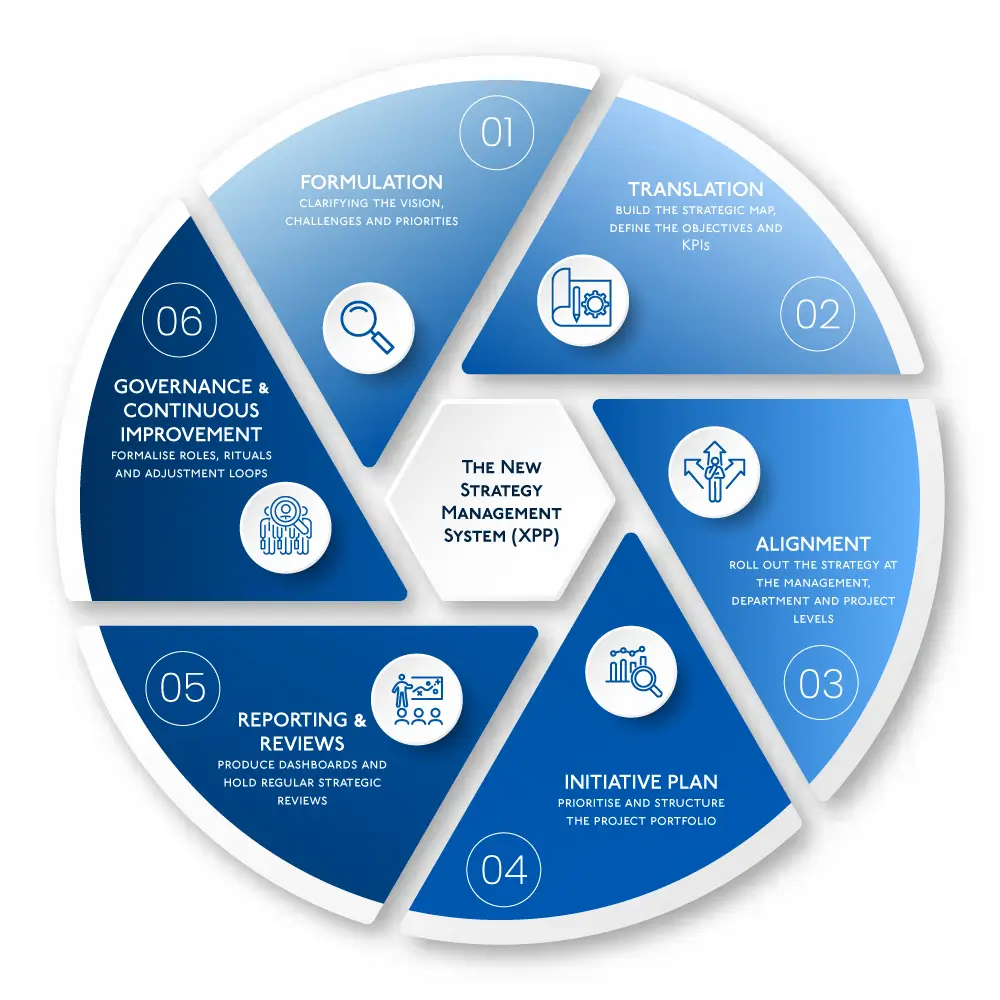
Adapted from the “New Strategy Management System” developed by Kaplan & Norton
By combining BSC and XPP, the organisation has a coherent system: from vision to measurable results.
4. Our approach: end-to-end support focused on capacity building
We offer integrated support, structured in four complementary blocks, with a clear positioning: to set up an execution system and build internal capacities to sustain it over the long term.
Block A — Reference framework: BSC & XPP
We help your organisation to:
- Adopt the BSC/XPP model: concepts, structures, examples of applications in the public sector.
- Visualise the future execution system: strategy map, dashboards, review cycle, role of committees.
- Clarify expectations for the system: transparency, accountability, coordination, results.

Block B — Preliminary steps: assessment & preparation
Before any implementation, we carry out a structured preparation phase, including:
Strategic framing of the project
- Scope: ministry, agency, programme, regulatory authority, etc.
- Key stakeholders: executive, management, donors, supervisory bodies
- Ambitions and expected results
Diagnosis of implementation capacity
- Current planning processes
- Budgeting and link to strategy
- Management information system
- Performance and reporting culture
Initial capacity building
- Raising awareness among decision-makers of the BSC/XPP approach
- Preparation for the creation of an internal core team that will drive the implementation
Block C — Organisational architecture of the programme
We assist the organisation in setting up three key teams:
Management / top management
- Decides on major policy directions;
- Approves the strategic roadmap, objectives and priorities;
- Decides on budgetary trade-offs and initiative priorities.
Measurements & performance
- Defines key performance indicators (KPIs) and targets;
- Organises data collection and reliability;
- Produces dashboards and analyses;
- Produces dashboards and analyses;
Operationnal Execution Team
- Plans and manages strategic initiatives;
- Aligns projects, activities and resources with the strategy;
- Gathers field information to feed into KPIs.
Block D — Institutionalisation: Office of Strategy Management (OSM)
The Office of Strategy Management (OSM) is at the heart of the execution mechanism. Its role is not to ‘formulate strategy’, but to:
- Act as architect and guarantor of the process and its execution in full compliance;
- Coordinate the strategic execution process;
- Ensure that monthly/quarterly reviews (operations/strategy) are held;
- Ensure consistency and alignment of the budget, human resources, key processes and strategy information;
- Ensure the continuity of reforms and transformations beyond changes in “people” or organisational structures;
- Document developments in the BSC/XPP system and its continuous improvement;
- Ensure communication and management of organisational change within the programme.
The OSM acts as the organisation’s architect and strategic control tower.
5. A capacity building and learning by doing approach
Unlike a purely “deliverables” approach, our approach is resolutely focused on developing internal capacities:
5.1 Systematic involvement of the client’s teams
The resources of the client organisation and its stakeholders are:
- Involved in the analysis phase (diagnosis, interviews, information gathering);
- Involved in the design phase (strategic map, objectives, KPIs, initiatives);
- Empowered in the deployment phase (change management, facilitation, monitoring, reporting).
The objective is that, at the end of the mandate, the organisation will be able to maintain the system without permanent dependence on an external consultancy.
5.2 Training the Core Team using a “Learning by Doing” approach
When forming and developing the skills of the core team (management team, implementation team, analytical team), we favour a teaching approach based on alternating theory and practice:
- Based on alternating theory and practice;
- Articulated around concrete cases from the organisation;
- Incorporating workshops for the co-construction of deliverables.
The working sessions produce directly usable elements:
- Draft strategic maps,
- Initial balanced scorecards,
- Portfolios of initiatives,
- Strategic review frameworks.
5.3 An agile method, adapted to the pace of the organisation
We adopt an agile approach in order to adjust:
- The pace of change to the organisation’s actual, assessed capabilities;
- The complexity of the system to the organisation’s evolving level of preparedness.
In concrete terms:
- Launch of a “pilot” (a department, a programme, a targeted scope);
- Short learning loops (1st cycle, then adjustment);
- Gradual evolution towards broader coverage (escalation).
6. Project phases and main deliverables
7. Benefits for the client organisation
By implementing this approach, the organisation can reasonably expect:
- A better understood and shared strategy at all levels;
- Greater consistency between strategy, budget, human resources, key processes and information resources;
- A performance culture based on factual data;
- An increased ability to report to citizens, donors and other stakeholders;
- A reduction in interrupted reforms, thanks to the discipline of steering and accountability;
- Institutionalisation of the strategy planning and execution process (via the OSM).
The objective is that, by the end of the mandate, the organisation will be able to sustain and further develop the system without relying permanently on an external consultancy.
8. Why choose us?
We position ourselves as a strategic partner to public institutions, combining:
- Proven expertise in strategy planning and execution
- Experts with professional certifications:
- Balanced Scorecard/XPP & Strategy Focused Organisation (USA – Harvard Publisher)
- PROSCI certification (USA) in organisational change management
- LMI certification (USA Leadership Management Institute)
- Diverse experience :
- Public and private reform and transformation projects
- Regulatory authorities, ministries, government agencies, financial institutions
- Multi-donor, multi-stakeholder contexts
- African and international environments

Our added value:
- A mix of consulting and support
- A structured and documented approach
- A focus on capacity building
- Close adaptation to the African institutional context
- A pragmatic and realistic approach
9. Terms of engagement and next steps
Depending on the scope (ministry, agency, reform or business transformation), we offer:
- An executive workshop/awareness seminar (2 days) for the management team;
- A training seminar for the core team and stakeholders: strategic planning and execution according to the BSC/XPP method (2 weeks);
- An express diagnosis of change management and execution capabilities;
- A comprehensive support mandate structured around the phases described above.
Would you like to benefit from tailored support on this matter?
Contact our Customer Service team to discuss this further.