The Recipe for Successful Leverage of AI: Human Beings Being (More) Human!
In a recent online article on the Harvard Business Review site (HBR.org, 2024), entitled “The Best Leaders Can’t Be Replaced by AI1,” the graphic below illustrates the authors’ conclusions on where AI should be used most effectively in organizations and the areas where « being human » should be leveraged.
AI Versus Human: A Matrix of Leadership Activities
A guide for leaders to assess where they should leverage AI versus where they should leverage being human.
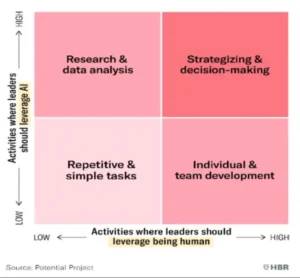
The area of strategizing and decision-making is identified as the one with the highest potential to benefit from using and leveraging AI—provided that high levels of “being human” are also utilized. I have already written an in-depth article2 demonstrating how generative AI tools can be used in the scenario planning process and explored the pros and cons of doing so. However, in light of the new HBR article, I thought it would be useful to explore what leveraging a high level of “being human” might entail.
First, we should highlight the possible negatives of being human that might be exacerbated through the use ofAI. For example, bringing our personal biases, fears, insecurities, selfish ambitions, personal enmities, jealousies, A.D.D., a tendency to empire build, and our ability to lie and deceive (others and ourselves) into ourinteractions with AI would probably best be avoided. Perhaps, over the long-term, new AI tools might serve todiminish or eliminate their impact on decision-making for the betterment of all.
To explore what a “high level of being human” might look like, I consulted four different generative AI bots. They all agree that there is an extensive list of human qualities, such as our emotions, sense of engagement, commitment and determination, personal ethics, integrity, judgment, personal values, our ability to empathize and be compassionate, deep listening, our passion, humour, sense of play, emotional intelligence, creativity, intuition, and feeling of connection, community, loyalty, trust, and friendship, that can all be important in strategizing, decision-making, and individual and team development. Interestingly enough, these are the elements of a human being that make each of us who (as opposed to what) we really are.
Our essential humanness
Our essential humanness includes our mindfulness, awareness, presence, and consciousness, our ability to capture what is and what is emerging. These attributes are not a function of our I.Q. nor do they reside in the physical brain. They are in what Annie Murphy Paul calls our “Extended Mind3,” an expandable sensing capability that continually “loops” between our brain-mind and our hearts, guts, body sensations, devices, technologies, local social field/space, and global consciousness.
Crucially, most of the human attributes important in strategic decision-making—and that are not replaceable by AI—do not reside in our heads.
Rather, it is our body’s interoception, exteroception, proprioception, and nociception sensitivity and capabilities, along with our “extended, looping minds,” which add unique irreplaceable human value. This “distributed cognition” capability allows us to create “the new” from the old and energize, engage, and mobilize our teams. After all, AI will never be able to be fully present and truly experience moments as they unfold or the emotional surge of the birth of a new idea. It will never experience the magic of individual or team “flow.”
Such a way of seeing ourselves and our value-added belies the belief of many educated professionals that, as the joke goes, our bodies are merely taxis that simply “transport our heads from one meeting to another.” It is, in fact, our ability to feel and sense into our hearts, guts, and bodies that allows us access to that essential humanness and bodily wisdom—or not.

Yes, given all the right data, AI can come up with the perfect “winning” business model, but so can any welloiled team of experienced, technical strategists who have mastered all the models and concepts. AI can just do it quicker. However, many of us who have been doing this work for a while know that having a bot announce the next business model, process change, structural reorganization, or strategic “pivot” will probably have as much success as the boss who devises the perfect decision in their office and walks out to tell everyone the major change they’ve decided is going to happen.
In another recent HBR article4, the results from a major study of 300 large companies worldwide show that, even with all the big data, new tools, and management experience in 2024, only 12% of major change (Transformation) programs produce lasting results. Just imagine all the lost time, money, energy, waste of human resources, and the enormous frustration, opportunity cost, and value destruction that is captured behind that statistic.
This failure has little to do with the actual quality of the decisions that were made. Such post-change “transformation” visions are often well-thought-out —probably the equivalent of anything that an AI bot could generate. The weaknesses lie in the lack of consideration of the “human experience” of the change/transformation processes and the inhumanity that exists in our organizational cultures, processes, strategies, structures, and decision-making.
Those of you who know me are well aware that I believe all the “strategizing” and decision-making models and concepts are nothing more than specialized tools to facilitate generative, embodied conversations. It is where the alchemy of creativity and innovation, co-creation, commitment, engagement, and team-building can occur. This “Flow” alchemy can only occur when full-bodied mindfulness, presence, and awareness are present.
The following paragraphs (unedited) show how each of the 4 Generative AI-bots I consulted finished their answers to my prompts regarding what a high-level of “being human” might actually mean:
This last statement, my personal favourite, best captures the reason why I believe “embodied decisionmaking”, that is, seeking to incorporate mindfulness and social presencing—along with full-body “strategic play” activities and movement practices throughout a decision-making process—is essential if we want to improve our global (12%!) “fail” performance in “transformation” efforts. We need to have strategic decisionmaking processes that truly allow us to “embrace the full richness of human experience.”
As described in my previous article5, the following closing paragraphs (generated by ChatGPT) perfectly captures my thoughts:
Social Presencing Theatre (SPT) (and other movement-based creativity methods) is based on the understanding that the body holds wisdom that is often invisible and inaccessible to the conscious mind. By exploring, observing and experiencing emerging bodily positions, movements, gestures and postures, SPT allows people to access deeper levels of awareness, creativity, empathy and connection.
Using physical movement (in combination with traditional tools) combines mindfulness, embodiment, and social systems thinking to help individuals and groups better understand complex system-wide patterns and dynamics and, as a result, to develop new perspectives and innovative solutions. Most importantly, these solutions are more effective and sustainable than solutions derived using more conventional decision-making approaches.
Only by recognizing, building and using our “extended, looping mind” competency i.e., our interoception, exteroception, proprioception, and nociception “muscles”—and risking being laughed out of the boardroom – can we truly capitalize on both AI and those unique human qualities that allow transformation to emerge, be implemented, and stick.
Having completed the above article, I asked ChatGPT to generate three Action items for you as “take homes”. It generated:
1. « Use AI to augment, not replace, human decision-making »
Focus the use of AI on data processing and pattern recognition, while humans handle the “human experience”, individual development, team-building and ethical considerations. Design AI tools to complement human capabilities.
2. « Implement Embodied Decision-Making »
Encourage practices like mindfulness, social presencing, and strategic play to engage the whole body and mind in strategising and decision-making. These methods foster creativity, holistic thinking, team building and a better understanding of complex system dynamics.
3. « Cultivate a Human-Centric Culture »
Foster a culture that values a human-centric paradigm and design thinking, empathy, ethics, and emotional intelligence. Emphasise these qualities in training and team-building to integrate human strengths with AI, improving both engagement and decision-making success.
In other words, bring more of your humanness (your entire being) to the workplace if you want to get the most from AI.
References:
1 “The Best Leaders Can’t Be Replaced by AI”: Rasmus Hougaard, Jacqueline Carter, and Rob Stembridge; (HBR.org 2024); Jan 12th 2024
2 Enhancing Scenario Planning with AI; Ivey Business Journal, May-June 2023
3 The Extended Mind: The Power of Thinking Outside the Brain; Annie Murphy; 2021; ISBN 978-0-358-69527-1
4 Transformations that Work; Michael Mankins & Patrick Litre (both partners at Bain), HBR May-June 2024
5 “What is the Unique Value of Social Presencing Theatre (SPT)?” LinkedIn; March 2023

MBA, M.Eng

Read more
Leading Beyond Reasoning: Webinar Recap
Exploring the Future of Visual Sensing in Strategic Planning
Enhancing Scenario Planning With AI