Exploring the Future of Visual Sensing in Strategic Planning

Over a few months last year, the authors of this paper facilitated a strategic-planning exercise for a large corporate business unit (BU) client working in the North American fibre-based packaging industry. The BU was seeking to refine its business strategy, create a new vision for a revamped management team and to position itself as an attractive investment opportunity for Head office.

Strategy consultant Iryna Baturevych explored how AI might enhance the exercise; Oksana Kandabura, a visual artist, used visual sensing and scribing techniques during the sessions to help the strategic-planning team better capture what was happening during them; and Mark Hollingworth, president of 5i Strategic Affairs, concentrated on hosting and facilitation. Although we knew each other, this was our first time working together on a consulting mandate. By collaborating, we sought to enhance the cold, hard data and analysis generated by models and conversations, while also sensing and capturing the equally important “warm/living data” tied to participants, which was ever-changing during the process.
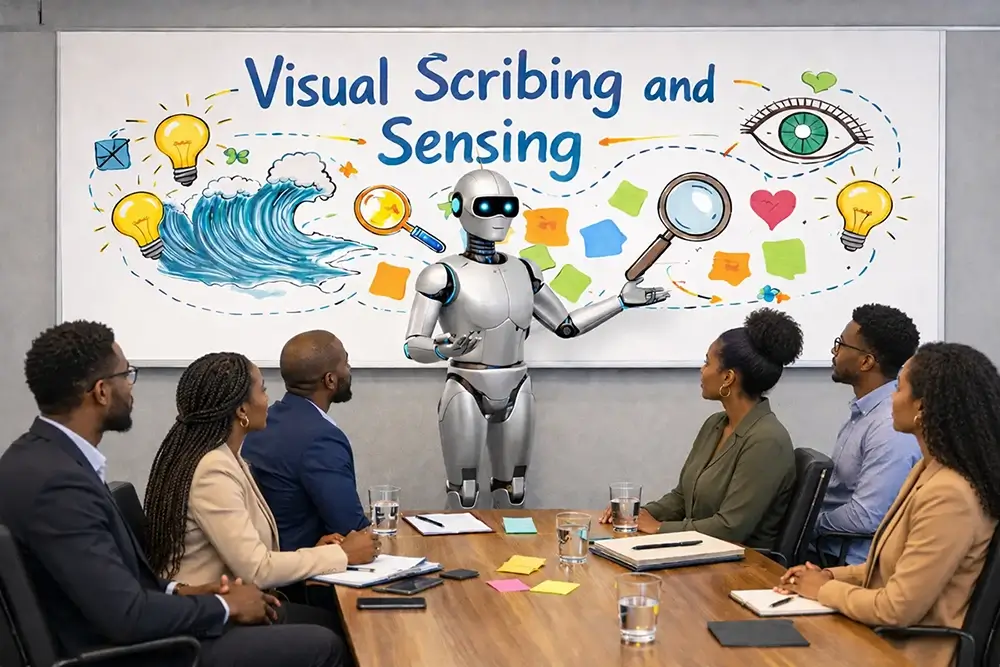
 

This article aims to explore how AI can help humans better interpret and learn from visual scribing/sensing imagery that is generated during strategic-planning meetings. Three AI tools—Gemini, Claude, and ChatGPT (using the Aiden Cinnamon Tea Sensibility Simulation Protocol 2.0)—were asked during the sessions and afterwards to interpret Kandabura’s artwork from each of the three two-day off-site retreats. Their outputs were merged for this article. We invite you to spend a minute or two observing this work (presented below) before reading the subsequent texts. What do you see/sense? How do you interpret them?

SESSION 1
Session 1
The introductory session

The introductory session brought together 20-plus team members from several facilities and geographic locations to create a shared intention, complete a diagnostic, and establish the “deep dives” required over the summer.

What did the artwork say to us?

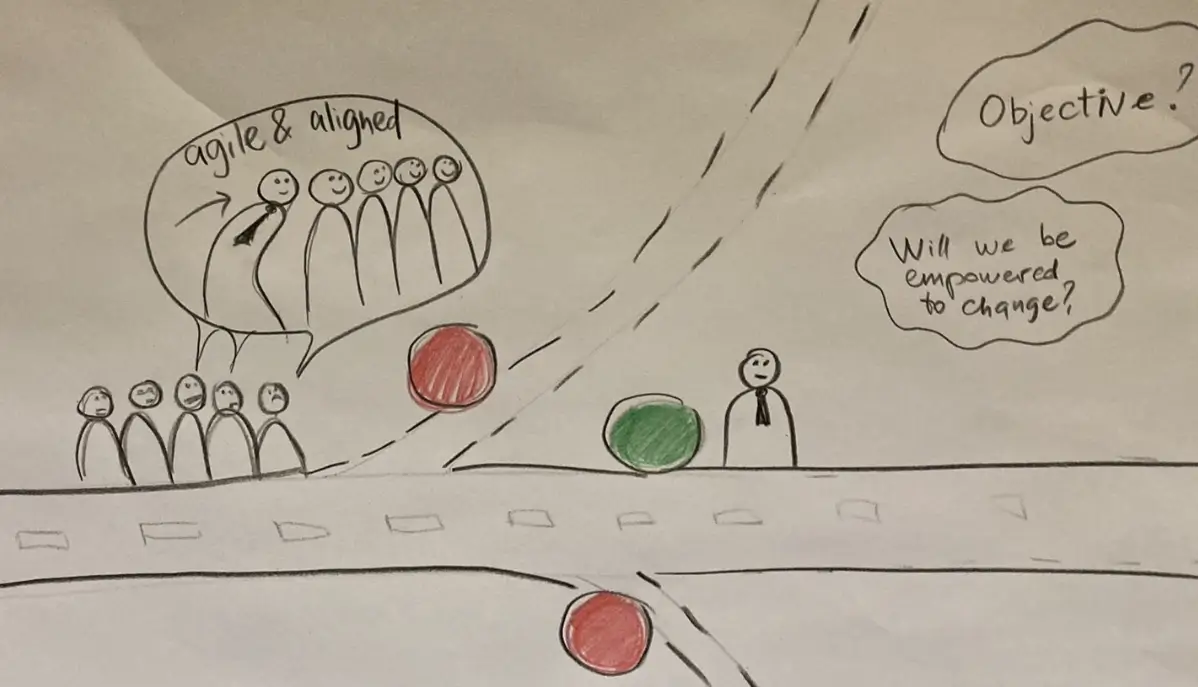
The team wanted to come together but weren’t there yet; they were aware that their decisions might not be supported by corporate; they had choices from a range of options—some clearer options were better than others; “more of the same” was still on the table; they wanted to come together as one going forward.

How did AI tools interpret the image?

This image captures a team at a strategic crossroads—not a straight path but a junction signalling uncertainty, choice, and multiple possible futures. The team framed its first meeting not as refinement of an existing plan, but as redirection.

On the left, a clustered group aspires to be “agile & aligned”; on the right, a lone figure stands apart near a green circle, while red circles appear along the road. The visual creates stark tension: cohesion versus separation, aspiration versus hesitation. The group appears unified but passive—close together but not moving. This may reflect a compliance-versus-commitment gap: the team knows the language of agility but does not yet feel it.

The most emotionally charged elements are the questions: “Objective?” and “Will we be empowered to change?” The lone figure near the green signal may represent leadership or decision rights that feel concentrated rather than shared—hinting at a history of top-down or predetermined planning.

Red circles—more numerous than green—suggest perceived obstacles. The team seems ready but is waiting to see whether the light turns green. This is not misalignment; it is a threshold moment. Psychological safety and genuine empowerment are the real hurdles. Without them, red signals multiply into cynicism. With them, the crossroads becomes momentum.

SESSION 2

Session 2

In the second session

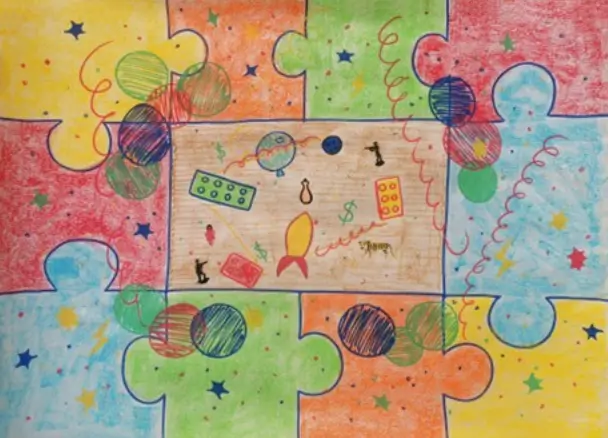
In the second session, the team worked on scenario planning and the identification of different visions for how the BU could move forward while Oksana created the following image.

What did the artwork say to us?

The image reflects the challenge of building a strategic plan while many pieces remain in motion—inviting patience and the willingness to move forward without complete clarity. At the centre sits a solid brown rectangle representing the company—stable but not a puzzle piece, hinting at the tension between stability and uncertainty. Around it, a vibrant mix of circles, puzzle pieces, stars, and confetti conveys playfulness, creativity, and lively collaboration.

How did AI tools interpret the image?

This second image reflects a shift from the first meeting’s anxiety toward energy, integration, and possibility. Interlocking puzzle pieces represent interdependence and diversity—strategy is no longer a straight path but a complex system. The bright colours, spirals, and lightning bolts signal that the team has moved from skepticism toward enthusiasm and psychological safety.

Overlapping circles along puzzle seams highlight cross-functional collaboration: value appears to emerge at the intersections, not within isolated pieces. Yet the centre remains symbol-rich and somewhat chaotic—many ingredients, but not yet a clear narrative. The rocket is ready; its trajectory is still undefined. If the first drawing reflected the anxiety of the unknown, this one expresses the joy of construction.

SESSION 3

Session 3

The final session

The final session focused on in-depth discussion of plausible alternatives, refining the draft “Strategic Temple” (a visual metaphor used to illustrate a company’s strategic plan on a single page) for the BU, and constructing strategic maps for its five facilities, located in different geographic markets across North America.

What did the artwork say to us?

This piece captures the bright, colourful energy of the team and the dynamic complexity of both the planning process and the Volatility, Uncertainty, Complexity, and Ambiguity (VUCA) environment in which the BU operates. The spirals and intersecting lines suggest ongoing development rather than closure: learning through iteration, revisiting key questions at deeper levels. The team appears to have found a rhythm together. Overall, the image represents energized collaboration, courageous truth-telling, systemic thinking, and a surprisingly clear shared vision emerging from complexity.

How did AI tools interpret the image?

This third image shows a further stage: from crossroads (decision) to puzzle (integration) to spiral field (flow). The rigid puzzle borders have dissolved—only flowing, interwoven spirals remain. The familiar colours no longer sit in separate domains; they overlap and blend. The team has moved beyond “we fit together” to “we are intertwined.” Multiple spiral centres may reflect distributed leadership and parallel initiatives. The earlier skepticism has evolved into shared ownership and psychological safety.

Across three meetings the movement is: separation → fitting together → flowing together. At its deepest level, the image feels less like a plan and more like an identity: strategy as patterned movement and shared momentum.

Process Evolution

As the AI noted:

The journey moves from anxiety and hierarchy → integration and construction → flow and systemic coherence and from questioning voice → assembling purpose → generating shared rhythm. It is a progression not just in strategic clarity, but in the increasing relational maturity of the group. The group stopped negotiating authority and started experiencing collective movement—a team ready not just to execute a plan, but to navigate complexity together with agility and mutual trust.

Ten Lessons Learned

1.

We used AI post-process and in private to glean the maximum from the images. In the future, we would use AI “in situ”—in front of participants at the end of each session—to provoke deeper discussion, and we would allocate significantly more time to the exercise.

2.

The main value of the AI tools interpreting each artwork was that they made explicit what was largely implicit to the team members: factors, connections, paradoxes, and irregularities were “put on the table” for all to see, without requiring any individual to have the courage to voice them. They certainly highlighted elements that neither we, as facilitators, nor the participants consciously voiced or noted.

3.

Although we used three AI models, one may be sufficient. Formats and styles differed, but no single tool proved clearly superior. It comes down to personal preference.

4.

Simply having someone in the room tasked with sensing the experience in each moment—and capturing it through art—changed the social field in the space, and for the better.

5.

The major challenge for facilitators is to create an atmosphere of openness, creativity, and (serious) play at the onset that welcomes visual sensing as a legitimate strategic-planning tool. Having someone formally appointed (and highly visible) in that role amplifies that openness.

6.

It takes courage to introduce visual sensing into corporate decision-making. As with anything new, you must be willing to fail—or learn. Nothing of value may emerge. But you will never know unless you try.

7.

You do not need artistic talent for visual sensing—although it is obviously an asset. You do need to set aside judgment and allow your hands to move freely. The golden rule: “Never second-guess yourself. If it feels right, let it happen.” There is no good or bad creation (after all, visual scribing/sensing is a form of “brainstorming”).

8.

When showing the art to the strategic-planning team in order to gather their insights and opinions, it is important for facilitators to emphasize that no comments are “good or bad.” Those with more comfort with “modern art” may offer more insights but an absolute novice may offer a viewpoint that proves invaluable and that no one else could see, feel, or express. They will only do so if they feel comfortable enough to share.

9.

“Warm data” elements such as buy-in, engagement, motivation, trust, and connection are vital to decision-making and change management, yet tough to capture in KPIs or PowerPoint. Capturing them in works of art may be the only way to articulate them.

10.

The left side of the brain seeks to understand and control the world in fragments—language, logic, explicit facts. The right side of the brain, excelling at implicit knowledge, ambiguity, paradox, and emotional intelligence, sees the world as an integrated, dynamic system. The left brain is naturally dominant; visual sensing allows the right brain to come to the fore. Perhaps this is what the world needs today.


The “Big” Insight

In the right hands, the use of AI for data collection and analysis at each step of the strategic-planning process and to assist with the creation of the final plan can save a lot of time and create a lot of value. The drawback is that it increases the focus of the strategic-planning team on what the “cold,” hard data and facts might tell them.

In order to expose, include, and highlight the “warm,” soft data that is equally important in the process, we believe that the use of visual sensing will prove essential to counterbalance the “left-brain” dominance and tendency. Never forget that strategic planning is as much a human “change” experience as a rigid exercise in analyzing data.

Perhaps most importantly, the client was happy at the end of the process: The BU created a shared vision of where the team was going and a roadmap to get there and had attained a high level of buy-in from all participants. “Our hypothesis is that AI, the social arts, and strategic-planning exercises constitute a perfect strategic-planning triad.”

Mark_Hollingworth

By Mark HOLLINGWORTH

MBA, M.Eng
Consultant expert in Team Management, Strategic Planning and Change Management
Further reading on this topic:

About Authors

Iryna BATUREVYCH

MA (publishing/journalism), is a goal-focused strategy consultant and program development manager with extensive experience developing impactful strategies for publishing businesses, government, and cultural non-profit initiatives. Baturevych combines data-driven decision-making with a creative, results-based approach. In 2009, she founded Chytomo, a leading web portal on publishing and culture in Ukraine and neighbouring countries. She holds a certificate in Supporting the Creative Economy from the British Council (in partnership with the Cultural Associates, Oxford)

Oksana KANDABURA

MA (business/managerial economics), is a visual artist. Through diverse work and volunteer roles across industries and multicultural environments in Ukraine, Mauritius, and Canada, Kandabura has gained a unique perspective blending business, artistic, and teaching experience. With a background of more than 10 years in project coordination, process improvement, and budget oversight, she brings a solid foundation in business operations alongside strengths in creative problem-solving, adaptability, and clear communication.

Mark HOLLINGWORTH

M.Eng, EMBA, president of 5i Strategic Affairs, is an expert in strategic leadership who has worked as a management consultant, workshop leader/facilitator, educator, and ontological coach for clients in the for-profit and not-for-profit sectors for over 30 years. In his mission to help “people, companies, and society prepare for sustainable success,” Hollingworth acts as process leader, guide, trusted supporter, and, when necessary, devil’s advocate, using his talent and experience to help individuals and organizations make crucial decisions that result in concrete action and change. In Canada, he has worked with industry leaders such as ArcelorMittal, Bank of Montreal, CITI, Cogeco, Dillon


↑ Back to top of the page.

The Recipe for Successful Leverage of AI: Human Beings Being (More) Human!

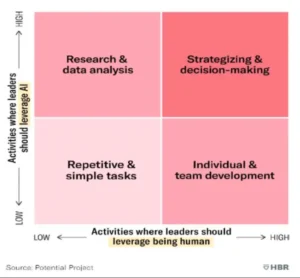
In a recent online article on the Harvard Business Review site (HBR.org, 2024), entitled “The Best Leaders Can’t Be Replaced by AI1,” the graphic below illustrates the authors’ conclusions on where AI should be used most effectively in organizations and the areas where « being human » should be leveraged.

AI Versus Human: A Matrix of Leadership Activities

A guide for leaders to assess where they should leverage AI versus where they should leverage being human.

The Recipe for Successful Leverage of AI: Human Beings Being (more) Human! - Mark Hollingworth

The area of strategizing and decision-making is identified as the one with the highest potential to benefit from using and leveraging AI—provided that high levels of “being human” are also utilized. I have already written an in-depth article2 demonstrating how generative AI tools can be used in the scenario planning process and explored the pros and cons of doing so. However, in light of the new HBR article, I thought it would be useful to explore what leveraging a high level of “being human” might entail.

First, we should highlight the possible negatives of being human that might be exacerbated through the use ofAI. For example, bringing our personal biases, fears, insecurities, selfish ambitions, personal enmities, jealousies, A.D.D., a tendency to empire build, and our ability to lie and deceive (others and ourselves) into ourinteractions with AI would probably best be avoided. Perhaps, over the long-term, new AI tools might serve todiminish or eliminate their impact on decision-making for the betterment of all.

To explore what a “high level of being human” might look like, I consulted four different generative AI bots. They all agree that there is an extensive list of human qualities, such as our emotions, sense of engagement, commitment and determination, personal ethics, integrity, judgment, personal values, our ability to empathize and be compassionate, deep listening, our passion, humour, sense of play, emotional intelligence, creativity, intuition, and feeling of connection, community, loyalty, trust, and friendship, that can all be important in strategizing, decision-making, and individual and team development. Interestingly enough, these are the elements of a human being that make each of us who (as opposed to what) we really are.

Our essential humanness

Our essential humanness includes our mindfulness, awareness, presence, and consciousness, our ability to capture what is and what is emerging. These attributes are not a function of our I.Q. nor do they reside in the physical brain. They are in what Annie Murphy Paul calls our “Extended Mind3,” an expandable sensing capability that continually “loops” between our brain-mind and our hearts, guts, body sensations, devices, technologies, local social field/space, and global consciousness.

Crucially, most of the human attributes important in strategic decision-making—and that are not replaceable by AI—do not reside in our heads.

Rather, it is our body’s interoception, exteroception, proprioception, and nociception sensitivity and capabilities, along with our “extended, looping minds,” which add unique irreplaceable human value. This “distributed cognition” capability allows us to create “the new” from the old and energize, engage, and mobilize our teams. After all, AI will never be able to be fully present and truly experience moments as they unfold or the emotional surge of the birth of a new idea. It will never experience the magic of individual or team “flow.”

Such a way of seeing ourselves and our value-added belies the belief of many educated professionals that, as the joke goes, our bodies are merely taxis that simply “transport our heads from one meeting to another.” It is, in fact, our ability to feel and sense into our hearts, guts, and bodies that allows us access to that essential humanness and bodily wisdom—or not.

Yes, given all the right data, AI can come up with the perfect “winning” business model, but so can any welloiled team of experienced, technical strategists who have mastered all the models and concepts. AI can just do it quicker. However, many of us who have been doing this work for a while know that having a bot announce the next business model, process change, structural reorganization, or strategic “pivot” will probably have as much success as the boss who devises the perfect decision in their office and walks out to tell everyone the major change they’ve decided is going to happen.

In another recent HBR article4, the results from a major study of 300 large companies worldwide show that, even with all the big data, new tools, and management experience in 2024, only 12% of major change (Transformation) programs produce lasting results. Just imagine all the lost time, money, energy, waste of human resources, and the enormous frustration, opportunity cost, and value destruction that is captured behind that statistic.

This failure has little to do with the actual quality of the decisions that were made. Such post-change “transformation” visions are often well-thought-out —probably the equivalent of anything that an AI bot could generate. The weaknesses lie in the lack of consideration of the “human experience” of the change/transformation processes and the inhumanity that exists in our organizational cultures, processes, strategies, structures, and decision-making.

Those of you who know me are well aware that I believe all the “strategizing” and decision-making models and concepts are nothing more than specialized tools to facilitate generative, embodied conversations. It is where the alchemy of creativity and innovation, co-creation, commitment, engagement, and team-building can occur. This “Flow” alchemy can only occur when full-bodied mindfulness, presence, and awareness are present.

The following paragraphs (unedited) show how each of the 4 Generative AI-bots I consulted finished their answers to my prompts regarding what a high-level of “being human” might actually mean:

ChatGPT

In essence, a manager with a high level of being human integrates compassion, ethical judgment, and a deep understanding of human dynamics into their strategic decision-making. This approach not only fosters a positive and productive workplace but also builds trust and loyalty among employees and stakeholders.

Gemini

The ideal scenario is a combination of AI and human intelligence. AI can handle the data analysis and provide options and insights, while humans use their judgment, empathy, and critical thinking to make the final decisions.

Copilot

Incorporating a high level of these human qualities can lead to a more holistic and balanced approach to management and strategy, fostering a work environment that values individuals and their contributions beyond just their output or productivity. It can also help in building trust, loyalty, and a positive organizational culture.

Perplexity

In essence, a high level of being human means not treating decision-making as a purely analytical exercise, but embracing the full richness of the human experience – our emotions, values, creativity, and ability to connect with and understand others. It results in more holistic, ethical, and impactful decisions.

This last statement, my personal favourite, best captures the reason why I believe “embodied decisionmaking”, that is, seeking to incorporate mindfulness and social presencing—along with full-body “strategic play” activities and movement practices throughout a decision-making process—is essential if we want to improve our global (12%!) “fail” performance in “transformation” efforts. We need to have strategic decisionmaking processes that truly allow us to “embrace the full richness of human experience.”

As described in my previous article5, the following closing paragraphs (generated by ChatGPT) perfectly captures my thoughts:

Social Presencing Theatre (SPT) (and other movement-based creativity methods) is based on the understanding that the body holds wisdom that is often invisible and inaccessible to the conscious mind. By exploring, observing and experiencing emerging bodily positions, movements, gestures and postures, SPT allows people to access deeper levels of awareness, creativity, empathy and connection.

Using physical movement (in combination with traditional tools) combines mindfulness, embodiment, and social systems thinking to help individuals and groups better understand complex system-wide patterns and dynamics and, as a result, to develop new perspectives and innovative solutions. Most importantly, these solutions are more effective and sustainable than solutions derived using more conventional decision-making approaches.

Only by recognizing, building and using our “extended, looping mind” competency i.e., our interoception, exteroception, proprioception, and nociception “muscles”—and risking being laughed out of the boardroom – can we truly capitalize on both AI and those unique human qualities that allow transformation to emerge, be implemented, and stick.

Having completed the above article, I asked ChatGPT to generate three Action items for you as “take homes”. It generated:


1. « Use AI to augment, not replace, human decision-making »

Focus the use of AI on data processing and pattern recognition, while humans handle the “human experience”, individual development, team-building and ethical considerations. Design AI tools to complement human capabilities.

2. « Implement Embodied Decision-Making »

Encourage practices like mindfulness, social presencing, and strategic play to engage the whole body and mind in strategising and decision-making. These methods foster creativity, holistic thinking, team building and a better understanding of complex system dynamics.

3. « Cultivate a Human-Centric Culture »

Foster a culture that values a human-centric paradigm and design thinking, empathy, ethics, and emotional intelligence. Emphasise these qualities in training and team-building to integrate human strengths with AI, improving both engagement and decision-making success.


In other words, bring more of your humanness (your entire being) to the workplace if you want to get the most from AI.

References:

1 “The Best Leaders Can’t Be Replaced by AI”: Rasmus Hougaard, Jacqueline Carter, and Rob Stembridge; (HBR.org 2024); Jan 12th 2024

2 Enhancing Scenario Planning with AI; Ivey Business Journal, May-June 2023

3 The Extended Mind: The Power of Thinking Outside the Brain; Annie Murphy; 2021; ISBN 978-0-358-69527-1

4 Transformations that Work; Michael Mankins & Patrick Litre (both partners at Bain), HBR May-June 2024

5 “What is the Unique Value of Social Presencing Theatre (SPT)?” LinkedIn; March 2023

Mark_Hollingworth

By Mark HOLLINGWORTH

MBA, M.Eng
Consultant expert in Team Management, Strategic Planning and Change Management
Further reading on this topic:


↑ Back to top of the page.