Exploring the Future of Visual Sensing in Strategic Planning

Over a few months last year, the authors of this paper facilitated a strategic-planning exercise for a large corporate business unit (BU) client working in the North American fibre-based packaging industry. The BU was seeking to refine its business strategy, create a new vision for a revamped management team and to position itself as an attractive investment opportunity for Head office.

Strategy consultant Iryna Baturevych explored how AI might enhance the exercise; Oksana Kandabura, a visual artist, used visual sensing and scribing techniques during the sessions to help the strategic-planning team better capture what was happening during them; and Mark Hollingworth, president of 5i Strategic Affairs, concentrated on hosting and facilitation. Although we knew each other, this was our first time working together on a consulting mandate. By collaborating, we sought to enhance the cold, hard data and analysis generated by models and conversations, while also sensing and capturing the equally important “warm/living data” tied to participants, which was ever-changing during the process.


This article aims to explore how AI can help humans better interpret and learn from visual scribing/sensing imagery that is generated during strategic-planning meetings. Three AI tools—Gemini, Claude, and ChatGPT (using the Aiden Cinnamon Tea Sensibility Simulation Protocol 2.0)—were asked during the sessions and afterwards to interpret Kandabura’s artwork from each of the three two-day off-site retreats. Their outputs were merged for this article. We invite you to spend a minute or two observing this work (presented below) before reading the subsequent texts. What do you see/sense? How do you interpret them?

SESSION 1

Session 1
The introductory session

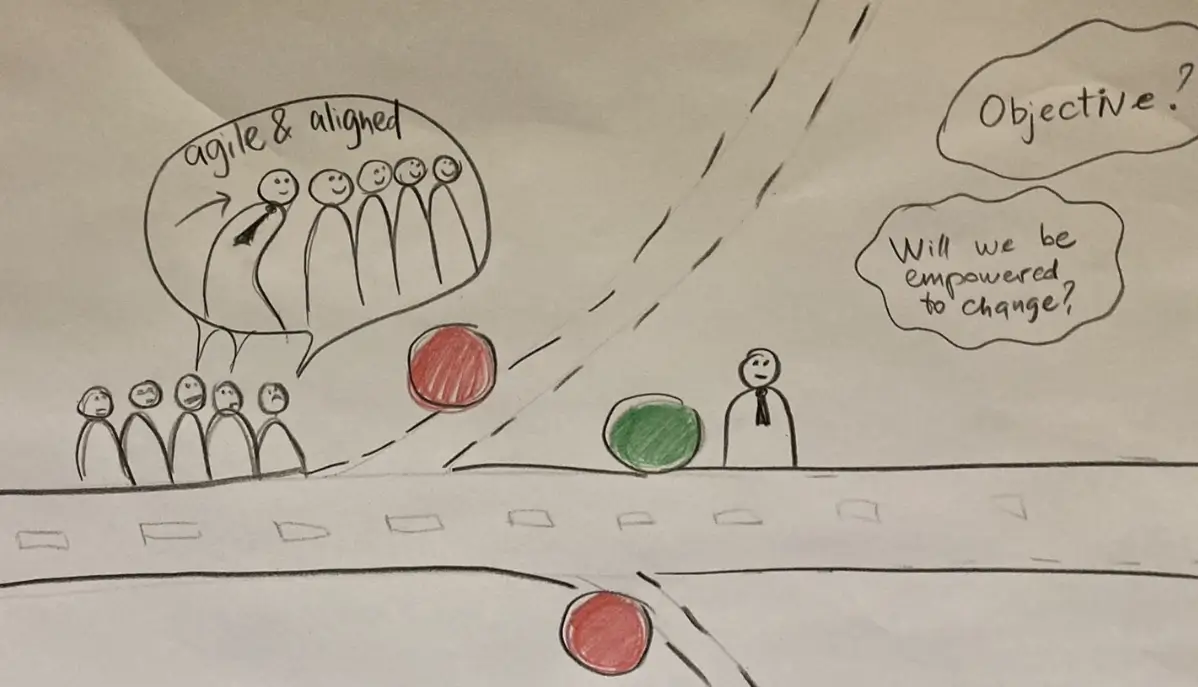
The introductory session brought together 20-plus team members from several facilities and geographic locations to create a shared intention, complete a diagnostic, and establish the “deep dives” required over the summer.

What did the artwork say to us?

The team wanted to come together but weren’t there yet; they were aware that their decisions might not be supported by corporate; they had choices from a range of options—some clearer options were better than others; “more of the same” was still on the table; they wanted to come together as one going forward.

How did AI tools interpret the image?

This image captures a team at a strategic crossroads—not a straight path but a junction signalling uncertainty, choice, and multiple possible futures. The team framed its first meeting not as refinement of an existing plan, but as redirection.

On the left, a clustered group aspires to be “agile & aligned”; on the right, a lone figure stands apart near a green circle, while red circles appear along the road. The visual creates stark tension: cohesion versus separation, aspiration versus hesitation. The group appears unified but passive—close together but not moving. This may reflect a compliance-versus-commitment gap: the team knows the language of agility but does not yet feel it.

The most emotionally charged elements are the questions: “Objective?” and “Will we be empowered to change?” The lone figure near the green signal may represent leadership or decision rights that feel concentrated rather than shared—hinting at a history of top-down or predetermined planning.

Red circles—more numerous than green—suggest perceived obstacles. The team seems ready but is waiting to see whether the light turns green. This is not misalignment; it is a threshold moment. Psychological safety and genuine empowerment are the real hurdles. Without them, red signals multiply into cynicism. With them, the crossroads becomes momentum.

SESSION 2

Session 2

In the second session

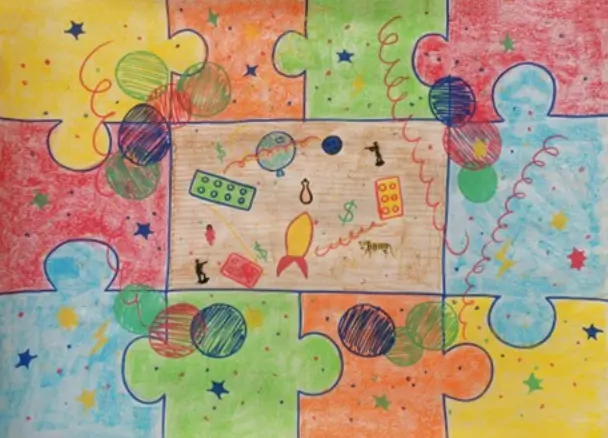
In the second session, the team worked on scenario planning and the identification of different visions for how the BU could move forward while Oksana created the following image.

What did the artwork say to us?

The image reflects the challenge of building a strategic plan while many pieces remain in motion—inviting patience and the willingness to move forward without complete clarity. At the centre sits a solid brown rectangle representing the company—stable but not a puzzle piece, hinting at the tension between stability and uncertainty. Around it, a vibrant mix of circles, puzzle pieces, stars, and confetti conveys playfulness, creativity, and lively collaboration.

How did AI tools interpret the image?

This second image reflects a shift from the first meeting’s anxiety toward energy, integration, and possibility. Interlocking puzzle pieces represent interdependence and diversity—strategy is no longer a straight path but a complex system. The bright colours, spirals, and lightning bolts signal that the team has moved from skepticism toward enthusiasm and psychological safety.

Overlapping circles along puzzle seams highlight cross-functional collaboration: value appears to emerge at the intersections, not within isolated pieces. Yet the centre remains symbol-rich and somewhat chaotic—many ingredients, but not yet a clear narrative. The rocket is ready; its trajectory is still undefined. If the first drawing reflected the anxiety of the unknown, this one expresses the joy of construction.

SESSION 3

Session 3

The final session

The final session focused on in-depth discussion of plausible alternatives, refining the draft “Strategic Temple” (a visual metaphor used to illustrate a company’s strategic plan on a single page) for the BU, and constructing strategic maps for its five facilities, located in different geographic markets across North America.

What did the artwork say to us?

This piece captures the bright, colourful energy of the team and the dynamic complexity of both the planning process and the Volatility, Uncertainty, Complexity, and Ambiguity (VUCA) environment in which the BU operates. The spirals and intersecting lines suggest ongoing development rather than closure: learning through iteration, revisiting key questions at deeper levels. The team appears to have found a rhythm together. Overall, the image represents energized collaboration, courageous truth-telling, systemic thinking, and a surprisingly clear shared vision emerging from complexity.

How did AI tools interpret the image?

This third image shows a further stage: from crossroads (decision) to puzzle (integration) to spiral field (flow). The rigid puzzle borders have dissolved—only flowing, interwoven spirals remain. The familiar colours no longer sit in separate domains; they overlap and blend. The team has moved beyond “we fit together” to “we are intertwined.” Multiple spiral centres may reflect distributed leadership and parallel initiatives. The earlier skepticism has evolved into shared ownership and psychological safety.

Across three meetings the movement is: separation → fitting together → flowing together. At its deepest level, the image feels less like a plan and more like an identity: strategy as patterned movement and shared momentum.

Process Evolution

As the AI noted:

The journey moves from anxiety and hierarchy → integration and construction → flow and systemic coherence and from questioning voice → assembling purpose → generating shared rhythm. It is a progression not just in strategic clarity, but in the increasing relational maturity of the group. The group stopped negotiating authority and started experiencing collective movement—a team ready not just to execute a plan, but to navigate complexity together with agility and mutual trust.

Ten Lessons Learned

1.

We used AI post-process and in private to glean the maximum from the images. In the future, we would use AI “in situ”—in front of participants at the end of each session—to provoke deeper discussion, and we would allocate significantly more time to the exercise.

2.

The main value of the AI tools interpreting each artwork was that they made explicit what was largely implicit to the team members: factors, connections, paradoxes, and irregularities were “put on the table” for all to see, without requiring any individual to have the courage to voice them. They certainly highlighted elements that neither we, as facilitators, nor the participants consciously voiced or noted.

3.

Although we used three AI models, one may be sufficient. Formats and styles differed, but no single tool proved clearly superior. It comes down to personal preference.

4.

Simply having someone in the room tasked with sensing the experience in each moment—and capturing it through art—changed the social field in the space, and for the better.

5.

The major challenge for facilitators is to create an atmosphere of openness, creativity, and (serious) play at the onset that welcomes visual sensing as a legitimate strategic-planning tool. Having someone formally appointed (and highly visible) in that role amplifies that openness.

6.

It takes courage to introduce visual sensing into corporate decision-making. As with anything new, you must be willing to fail—or learn. Nothing of value may emerge. But you will never know unless you try.

7.

You do not need artistic talent for visual sensing—although it is obviously an asset. You do need to set aside judgment and allow your hands to move freely. The golden rule: “Never second-guess yourself. If it feels right, let it happen.” There is no good or bad creation (after all, visual scribing/sensing is a form of “brainstorming”).

8.

When showing the art to the strategic-planning team in order to gather their insights and opinions, it is important for facilitators to emphasize that no comments are “good or bad.” Those with more comfort with “modern art” may offer more insights but an absolute novice may offer a viewpoint that proves invaluable and that no one else could see, feel, or express. They will only do so if they feel comfortable enough to share.

9.

“Warm data” elements such as buy-in, engagement, motivation, trust, and connection are vital to decision-making and change management, yet tough to capture in KPIs or PowerPoint. Capturing them in works of art may be the only way to articulate them.

10.

The left side of the brain seeks to understand and control the world in fragments—language, logic, explicit facts. The right side of the brain, excelling at implicit knowledge, ambiguity, paradox, and emotional intelligence, sees the world as an integrated, dynamic system. The left brain is naturally dominant; visual sensing allows the right brain to come to the fore. Perhaps this is what the world needs today.


The “Big” Insight

In the right hands, the use of AI for data collection and analysis at each step of the strategic-planning process and to assist with the creation of the final plan can save a lot of time and create a lot of value. The drawback is that it increases the focus of the strategic-planning team on what the “cold,” hard data and facts might tell them.

In order to expose, include, and highlight the “warm,” soft data that is equally important in the process, we believe that the use of visual sensing will prove essential to counterbalance the “left-brain” dominance and tendency. Never forget that strategic planning is as much a human “change” experience as a rigid exercise in analyzing data.

Perhaps most importantly, the client was happy at the end of the process: The BU created a shared vision of where the team was going and a roadmap to get there and had attained a high level of buy-in from all participants. “Our hypothesis is that AI, the social arts, and strategic-planning exercises constitute a perfect strategic-planning triad.”

Mark_Hollingworth

By Mark HOLLINGWORTH

MBA, M.Eng
Consultant expert in Team Management, Strategic Planning and Change Management
Further reading on this topic:

About Authors

Iryna BATUREVYCH

MA (publishing/journalism), is a goal-focused strategy consultant and program development manager with extensive experience developing impactful strategies for publishing businesses, government, and cultural non-profit initiatives. Baturevych combines data-driven decision-making with a creative, results-based approach. In 2009, she founded Chytomo, a leading web portal on publishing and culture in Ukraine and neighbouring countries. She holds a certificate in Supporting the Creative Economy from the British Council (in partnership with the Cultural Associates, Oxford)

Oksana KANDABURA

MA (business/managerial economics), is a visual artist. Through diverse work and volunteer roles across industries and multicultural environments in Ukraine, Mauritius, and Canada, Kandabura has gained a unique perspective blending business, artistic, and teaching experience. With a background of more than 10 years in project coordination, process improvement, and budget oversight, she brings a solid foundation in business operations alongside strengths in creative problem-solving, adaptability, and clear communication.

Mark HOLLINGWORTH

M.Eng, EMBA, president of 5i Strategic Affairs, is an expert in strategic leadership who has worked as a management consultant, workshop leader/facilitator, educator, and ontological coach for clients in the for-profit and not-for-profit sectors for over 30 years. In his mission to help “people, companies, and society prepare for sustainable success,” Hollingworth acts as process leader, guide, trusted supporter, and, when necessary, devil’s advocate, using his talent and experience to help individuals and organizations make crucial decisions that result in concrete action and change. In Canada, he has worked with industry leaders such as ArcelorMittal, Bank of Montreal, CITI, Cogeco, Dillon


↑ Back to top of the page.

Enhancing Scenario Planning With AI

…or why the work of strategic planning professionals needs to radically change with the widespread adoption of AI in organisations.

The disruptive potential of artificial intelligence (AI) has been on the minds of many professionals since the public launch of ChatGPT in late 2022. Just as previous technological revolutions deeply affected certain industries or types of work, AI is seen as a possible major disruptor in areas such as law, science, research, education, and training—and in decision making at the middle to upper levels of organizations.

This article explores how AI tools may threaten or provide new opportunities for people like me: consultants or facilitators in the area of strategic planning. More specifically, it explores how ChatGPT might affect the challenges faced by strategists in leading management teams through a key part of strategic planning exercises: scenario planning.

Participants et consultant en séminaire à Kuala Lumpur

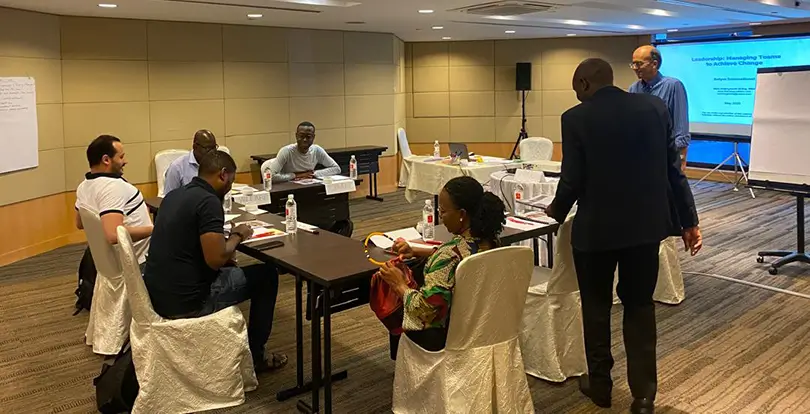
Scenario planning is an essential part of any strategic planning exercise. After all, most strategic plans aim to position us—and give us a roadmap forward—for success in three to five years’ time. To do this task effectively, surely it is more important to “paint pictures” and gain a good sense of what those potential, plausible futures might look like, rather than analyze current or historical data.

Nevertheless, for many, scenario planning is seen as a linear, quantifiable exercise aimed at trying to predict what the future will look like. When done well, it can be much more than that; it can grant the possibility to “learn from the future,” to use our imaginations, to tap into our felt sense and intuition, and to allow new strategies, visions, and paths forward to emerge from a generative, collective space—a space that is the strategic planning facilitator’s challenge to create, hold, and manage.

Imagining, however, does not come naturally to leadership teams who are used to either (a) believing they know what the future will look like or (b) believing the answer they seek can somehow be miraculously discovered by deeper analysis of available data. Many management teams or leaders are also not as open as they think to having their assumptions, ideas, and worldview challenged—particularly around the “big” potentially divisive and decisive strategic questions they face.

Maîtriser l’exécution stratégique

Generally, CEOs do not need much convincing to undertake a SWOT analysis as part of their strategic planning exercise; however, the answer of “I can’t know until we’ve done it” is not the most convincing answer to the question, “What will we get out of doing scenario planning?”—which is frequently asked by CEOs. The significant time needed to invest in scenario planning can also function as a barrier for the sceptics resistant to committing to the process.

So, how can ChatGPT add value to the scenario planning process?

As a “case study,” I decided to use ChatGPT to help me travel quickly though the scenario planning process in order to explore how environmental issues affecting the Canadian mining industry might change in the next few years. My experiment focuses on mining operations in Canada as opposed to Canadian companies operating in other parts of the world, although many of the lessons apply to them too. I chose this sector because of my education and early work experience in the sector and also because some of the current archaic paradigms, managerial decisions, and actions in the industry—including resistance to paying remediation costs, exploitation of worker rights, and divide-and-conquer strategies used vis-à-vis Indigenous groups—continue to boggle my mind.
Although the case is centred on the Canadian mining industry, the learnings are universal and applicable to all resource-based industries in all countries. (Note: Throughout this article, ChatGPT’s contributions are in italics.)

Launching The Case Study

I started by asking ChatGPT to identify the 20 forces that it considered would shape the environmental issues of the mining industry in Canada in the next three to five years. It answered in less than 20 seconds:

1. Climate change
2. Water scarcity
3. Biodiversity loss
4. Resource depletion
5. Air pollution
6. Waste management
7. Energy consumption and efficiency
8. Carbon emissions and mitigation
9. Land use and land management
10. Renewable energy and energy storage
11. Sustainability reporting and transparency
12. Environmental regulations and compliance
13. Social license to operate
14. Indigenous rights and reconciliation
15. Stakeholder engagement and communication
16. Health and safety of workers and communities
17. Emerging technologies and innovation
18. Circular economy and responsible sourcing
19. Responsible investment and financing
20. Supply chain management and logistics

These items would work as part of a checklist to ask, “How are we doing in each of these areas?” or “Which areas are we prioritizing or ignoring (group by green, yellow, or red)?” and would be a great opening icebreaker for a spirited dialogue among a management team.

In a real-life working session, the subsequent process of whittling down this list of factors to only two (to serve as axes for a Scenario Cross (the most simple and effective methodology for developing scenarios) could easily take an hour or more. With ChatGPT, it takes a few seconds. This is obviously very efficient; however, the rich debate required among a team to choose two forces from 20 is one of the major benefits of doing scenario planning. It forces participants to be open, to listen to and appreciate the views of others, and to access a different type of knowledge or wisdom—one that spending more time working on an Excel spreadsheet will not give them. Such a discussion advances a move towards a shared understanding and consensus and to building a unified team. It is lost if you allow ChatGPT to do the task.

When asked for the two most important forces, ChatGPT said:

Climate Change

This force could have significant implications for the mining industry, especially in Canada, where melting permafrost and changing precipitation patterns could increase the risk of landslides, floods, and other natural disasters. Additionally, stricter carbon emission regulations and policies may increase the cost of operations and affect the social license to operate.

Social License to Operate

This force is crucial for the mining industry in Canada, where Indigenous peoples and local communities play a vital role in decision-making processes. Maintaining a social license to operate requires engaging with stakeholders and addressing their concerns, which can be challenging and costly for the industry. Failure to obtain or maintain social license to operate can result in project delays, lawsuits, and reputational damage.

ChatGPT ended this section with:

It is important to note that the mining industry’s impact on the environment is complex and multi-faceted, and addressing environmental issues will require a comprehensive and collaborative approach from all stakeholders involved.

Although all mining companies pay lip service to adopting a “comprehensive and collaborative approach with all stakeholders involved” in dealing with their environmental impacts, it is rarely sincere. The truth is that many make weak attempts at “greenwashing.” It is interesting to consider whether such a call for the industry to take a radically different approach from a third-party “bot” may have more impact than the same message from a well-meaning consultant or facilitator such as myself.

I then asked ChatGPT to give me what it thought would be the maximum and minimum impacts of climate change on the environmental issues facing the mining industry in Canada over the next three to five years. It responded:

The minimum impact that climate change might have on the mining industry in Canada in the next 3-5 years could be limited to incremental changes in regulatory requirements, higher operating costs, and increased scrutiny from stakeholders, including investors, customers, and the public. This could result in increased pressure on mining companies to adopt more sustainable practices and technologies, such as energy efficiency measures, renewable energy sources, and water conservation strategies. Companies that are proactive in addressing climate change risks and opportunities may have a competitive advantage in the market and benefit from positive reputation and brand image.

On the other hand, the maximum impact that climate change might have on the mining industry in Canada in the next 3-5 years could be much more severe, especially if extreme weather events, such as floods, wildfires, and droughts, become more frequent and intense. These events could disrupt mining operations, damage infrastructure, and cause supply chain disruptions. Additionally, stricter carbon regulations and policies could increase the cost of production and limit access to financing and investment. Social license to operate could also be affected, as communities and stakeholders may become more vocal and organized in their demands for climate action and sustainability.

When asked the same question about the “social license to operate,” it generated this answer:

The minimum impact that social license to operate might have on the mining industry in Canada in thenext 3-5 years could be limited to incremental changes in stakeholder engagement practices and increasedreporting requirements. Companies may need to improve their communication and consultation withIndigenous communities, local residents, NGOs, and other stakeholders to address concerns related toenvironmental and social impacts, land rights, and resource sharing. This could result in some delays andadditional costs, but it may also improve relations with stakeholders and enhance the company’sreputation and brand image.

On the other hand, the maximum impact that social license to operate might have on the mining industryin Canada in the next 3-5 years could be much more significant, especially if there is widespread oppositionto mining projects, blockades, and legal challenges. Indigenous communities, in particular, may demandmore control and ownership over resource development, and may be more assertive in their opposition tomining projects that do not align with their values and priorities. This could lead to project delays, cancellations, and reputational damage for mining companies, as well as broader social and politicalconflicts.

In summary, the potential impact of social license to operate on the mining industry in Canada in the next 3-5 years could vary widely depending on the effectiveness of stakeholder engagement practices, the levelof trust and mutual understanding between mining companies and communities, and the broader politicaland social context in which mining takes place. Companies that are proactive in addressing social andenvironmental concerns, and that prioritize community engagement and consultation, may have acompetitive advantage in obtaining and maintaining social license to operate.

I find that the final summary paragraph sends a powerful message to the industry. Again, the questioncan be asked as to whether ChatGPT is a better channel for this message than I can be.

I then asked ChatGPT to generate four scenarios for the future of the mining industry in Canada using these two forces. In less than half a minute, it came back with:

“Green Mining”

This scenario involves mining companies that have obtained a strong social license to operate and are leaders in addressing climate change risks and opportunities. These companies have implemented sustainability practices and technologies, such as renewable energy sources and carbon capture, to reduce their environmental impact and enhance their reputation. They have also engaged with stakeholders, including Indigenous communities, to ensure their projects are aligned with local values and priorities. This scenario is characterized by low regulatory risk and strong investment potential.

“Social Unrest”

This scenario involves mining companies that have neglected to engage with stakeholders and address their concerns, leading to social unrest and opposition. This may be exacerbated by climate change impacts, such as extreme weather events, that affect local communities and create a sense of urgency around sustainability issues. This scenario is characterised by high regulatory risk, increased operating costs, and reputational damage for mining companies that fail to build trust with stakeholders.

“Compliance Only”

This scenario involves mining companies that have obtained a social license to operate through compliance with regulatory requirements, but have not taken proactive measures to address climate change risks and opportunities. These companies may face pressure from investors, customers, and the public to adopt more sustainable practices, but may lack the resources or expertise to do so. This scenario is characterized by moderate regulatory risk and a mixed investment outlook.

“Climate Shutdown”

This scenario involves mining companies that are forced to shut down operations due to the impacts of climate change, such as extreme weather events or regulatory action to reduce greenhouse gas emissions. These companies may have neglected to address climate change risks or have been unable to adapt to changing environmental conditions. This scenario is characterized by high regulatory risk and reputational damage.

“ChatGPT partially fell into the trap that many humans do when creating scenarios: it focused on company behaviour more than market dynamics.”

In the past, large consulting companies have answered requests for proposals from industry associations or government agencies to generate similar “generic” industry scenarios and have been generously compensated for it. This represents the worst of both worlds, as there is no real dialogue and it is a lengthy and expensive exercise. Hopefully, the emergence of AI will put an end to this practice.

Interestingly enough, ChatGPT partially fell into the trap that many humans do when creating scenarios: it focused on company behaviour more than market dynamics. However, I do believe the use of these four scenarios could enable a management team to have some incredibly rich, generative dialogue that they would not have if they did not undertake scenario planning.

The question as to whether it is more valuable to discuss the scenarios quickly generated by ChatGPT rather than have the conversation a team would in generating their own scenarios is a tough call to make. The jury is still out, I believe.

I then asked ChatGPT to generate the “No Regrets” actions (i.e., those actions where companies cannot lose by doing them) emerging from this exercise: It came back with:

Improve Energy Efficiency

Mining companies can invest in energy-efficient technologies and processes to reduce their energy consumption and greenhouse gas emissions. This can help reduce operating costs and improve the company’s environmental performance, while also enhancing its reputation with stakeholders.

Adopt Renewable Energy

Mining companies can explore the use of renewable energy sources, such as wind, solar, and hydro power, to reduce their reliance on fossil fuels and lower their carbon footprint. This can help mitigate climate change risks and reduce operating costs in the long term.

Engage with Stakeholders

Mining companies can engage with stakeholders, including Indigenous communities, local residents, and environmental groups, to understand their concerns and incorporate their feedback into project planning and execution. This can help build trust and maintain a social license to operate, even in the face of changing social and environmental conditions.

Invest in Innovation

Mining companies can invest in research and development to improve their environmental performance and develop new technologies and products that meet changing market demands. This can help position the company for long-term success and reduce its exposure to environmental and social risks.

Enhance Reporting and Transparency

Mining companies can improve their reporting and disclosure practices to provide stakeholders with more information about their environmental and social performance. This can help build trust and improve the company’s reputation, even in the face of changing social and environmental conditions.

I will let you decide which of the above are currently being pursued as strategic priorities across Canada’s mining industry. We could all probably agree that if they’re not all being practised, they should be.

I proceeded to ask ChatGPT to suggest what all mining companies should definitely stop doing or not do in Canada in the next three years, given climate change and changes in “social license to operate” conditions.

It gave me:

They should stop:

Ignoring Climate Change Risks

Mining companies should avoid ignoring the risks associated with climate change, such as extreme weather events, water scarcity, and increased regulatory scrutiny. Failing to address these risks could lead to reputational damage, regulatory fines, and operational disruptions.

Disregarding Stakeholder Concerns

Mining companies should avoid disregarding the concerns of stakeholders, including Indigenous communities, local residents, and environmental groups. Failure to engage with stakeholders and address their concerns could lead to social unrest, regulatory delays, and reputational damage.

Neglecting Environmental Impacts

Mining companies should avoid neglecting their environmental impacts, such as air and water pollution, land degradation, and biodiversity loss. Failing to address these impacts could lead to environmental fines, reputational damage, and legal liabilities.

Avoiding Transparency

Mining companies should avoid avoiding transparency with their environmental and social performance. Lack of transparency can erode trust with stakeholders and lead to reputational damage.

Focusing Only on Short-Term Gains

Mining companies should avoid focusing only on short-term financial gains at the expense of long-term environmental and social sustainability. This could lead to reputational damage and financial risks in the long run.

For me, these messages were the “golden nuggets” from this exercise—and certainly recommendations that should or could be enacted across the entire natural resource sector in Canada or anywhere else.
Holding tough conversations about how a company is doing in these five areas would more than justify an entire scenario planning exercise.

Without the use of ChatGPT, leading a team to the point where you might put such topics on the table could take days of working sessions and individual coaching and possibly weeks of “deep dive” work. With ChatGPT, the entire exercise can be done in under five minutes, in real time, in front of them.
I then decided to “squeeze the lemon” one last time to see if I could extract some additional recommendations, ideas, and questions that would assist a mining company in addressing its environmental challenges.

It suggested that mining companies could:

Invest in New Technologies

Mining companies could invest heavily in developing and deploying new technologies to reduce their environmental impact, such as carbon capture and storage, advanced water treatment, and autonomous mining equipment. This could position them as leaders in sustainable mining practices and help mitigate risks associated with climate change and social license to operate conditions.

Adopt Circular Economy Models

Mining companies could shift towards circular economy models that prioritize resource efficiency, reuse, and recycling. This would involve developing new business models and collaborating with other stakeholders to create closed-loop systems that minimize waste and resource depletion. This could help reduce environmental impact, improve efficiency, and build trust with stakeholders.

Pursue Social Innovation

Mining companies could take risks by pursuing social innovation initiatives, such as partnering with Indigenous communities, creating social enterprises, or investing in education and training programs for local residents. This could help build stronger relationships with stakeholders and foster social and economic development in mining regions.

Embrace Transparency and Accountability

Mining companies could take a risk by embracing transparency and accountability, including reporting on their environmental and social performance, engaging with stakeholders, and being open about their governance structures and decision-making processes. This could help build trust with stakeholders and differentiate them from peers that are perceived as less transparent.

Diversify into New Commodities

Mining companies could diversify their operations and explore new commodities, such as lithium, cobalt, or rare earth elements, that are in high demand for renewable energy technologies. This could position them as leaders in the transition to a low-carbon economy and provide a new source of growth in the face of changing market conditions.

Adopt a “Zero Harm” Mindset

Mining companies can adopt a “Zero Harm” mindset that prioritizes safety, health, and environmental stewardship. This can help build trust with stakeholders and create a culture of continuous improvement that enables the company to adapt quickly to changing circumstances.

Focus on Resource Efficiency

Mining companies can focus on resource efficiency by implementing strategies to reduce water and energy use, optimize mineral recovery rates, and minimize waste. This can help improve the company’s bottom line and build resilience in the face of changing market conditions.

Embrace Digital Transformation

Mining companies can embrace digital transformation by investing in technologies such as automation, machine learning, and data analytics. This can help improve efficiency, reduce costs, and enable the company to adapt quickly to changing circumstances.

Strengthen Stakeholder Engagement

Mining companies can strengthen their stakeholder engagement practices by building strong relationships with local communities, Indigenous peoples, and other key stakeholders. This can help build trust and social license to operate, enabling the company to adapt quickly to changing circumstances.

Develop Talent and Skills

Mining companies can focus on developing the talent and skills of their employees, particularly in areas such as sustainability, innovation, and stakeholder engagement. This can help build a workforce that is equipped to adapt quickly to changing circumstances and contribute to the long-term success of the company.

In this mini case study of the mining industry, the ideas and recommendations generated by ChatGPT are much more a collection of environmental best practices for resource companies than an environmental strategy for any single mining company. Hence, for governments, industry associations, or companies seeking to improve their environmental business practices, the outcomes are a gold mine.

But as Michael Porter once said, “Benchmarking is not strategy.” The results suggest that ChatGPT will have its limitations in terms of developing unique, winning strategies for specific companies. Strategy is about being different and operating differently—and each company is unique. Similar advanced AI tools developed by companies for their own purposes may prove better at this, but based on my current assumptions, “the answers will always emerge in the room, not through the bot.” (Disclaimer: I believe that this is how it ought to be.)

Having completed the exercise, I realized that many of the “2023 Environmental Best Practices” that emerged for the mining industry would also be relevant in all sectors that exploit land—be they pulp and paper, forestry, agriculture, oil and gas companies or ministries of fisheries, transport, infrastructure development, energy, etc.—and that the outcomes are applicable in all countries. The exercise represents an impressive output with minimum investment.

Quick lessons learned on “collaborating” with AI/ChatGPT

1.

ChatGPT can definitely contribute enhanced data and new ideas and can serve as a powerful reality check and challenge to prevailing groupthink. Most importantly, it can do a lot of “lowvalue,” time-consuming work in an incredibly short period of time, leaving more time for deeper, high-value, generative activities in the strategic planning process. This should change everything about how strategic planning facilitators approach their work.

2.

Similar to Zoom, Teams, Meet, or any software designed for creating the space for virtual meetings, ChatGPT can allow us to do things previously unthinkable, but it can also quickly become “the centre of gravity” as opposed to simply a powerful tool—with strengths and weaknesses—that we selectively use for specific activities.

3.

The value of having teams work together to generate scenarios in messy, sometimes tense conversations cannot be overstated. Strategic planning is really nothing but one extended conversational process about the big strategic issues and dilemmas that any company faces. For those simply seeking a “plan” (i.e., a document), using ChatGPT can eliminate the need to hold such conversations—but there is something incredibly valuable lost by doing so. However, sometimes a document is all that is sought or needed. Alternatively, with the judicious use of ChatGPT, it is possible to create an enhanced social field for even higher-quality interactions and conversations to take place during a strategic planning exercise. (Learning the “how/when” of that is probably the challenge I face in the coming months and years.)

4.

Using ChatGPT as a tool in “real time” in work sessions as a scenario generator and third-party “provocateur” offers enormous potential—as long as it can maintain a certain neutrality and objectivity and isn’t seen to favour a particular paradigm of business or behaviour. The ethics and objectivity of those controlling the data flowing into any specific AI tool will be critical. Asking the best, clearest, and most unbiased questions to the AI is also key.

5.

As a consultant who often works on projects alone, although the advent of Zoom and videoconferencing allows me to quickly collaborate with others on projects at short notice without leaving my office, having ChatGPT at my disposable gives me an incredible tool to make sure I continually challenge my own “background of shared obviousness”—and stay fresh and open to novelty and innovation. It’s worth asking: “Should ChatGPT be listed as a co-author or collaborator on this article?”

6.

During this experiment (and in other work with ChatGPT), I have not always agreed with everything it has generated in answer to questions I’ve posed. That’s a good thing. It has forced me to stay open to views dissimilar or even diametrically opposed to my own.

7.

As a strategic planning facilitator, you don’t need to be an industry expert to do a great job. However, some knowledge is very useful, and the use of ChatGPT to move up the learning or information curve when working in a new-to-you industry certainly offers the potential to add more value and be more efficient in this task and to save on our main resource: time.

8.

ChatGPT (and other AI tools) will cause the work of a strategic planning consultant or facilitator to change. It may well encourage a move from billing for “time” (which can be greatly reduced by using “bots”) to billing for “value.” That will require leveraging AI to create more value than ever—which is definitely possible if we’re willing to change and “be different.”

Some deeper lessons

1.

With or without AI, the challenge of a strategic planning facilitator remains the same: to create the ideal space (or social field) where the best decisions possible can emerge with maximum buyin from all stakeholders. This means ensuring that all types of consciousness and intelligence (i.e., intellectual, emotional, intuitive, bodily, collective, and global) are available and leveraged. AI offers the potential to enhance access to some of these—while also potentially distancing us from other forms of knowing. Earlier in this article, I mentioned that scenario planning can be either a mundane quantifiable exercise (horizontal knowledge) or a means to tap into our collective felt sense/intuition (vertical intelligence). AI is a great “horizontal” management tool; however, we already have a lot of those, and it is the facilitator’s creative use of it that determines if it can enhance “vertical leadership” wisdom and insight.

2.

Many years ago, Peter Drucker was quoted as saying, “The leader of the past was a person who knew how to tell. The leader of the future will be a person who knows how to ask.” In retrospect, the easiest way to have written this article would have been to simply ask some good, clear questions to ChatGPT! Simply asking it, “How can ChatGPT add value to the strategic planning process?” or “What are the pros and cons of using AI to generate scenarios?” could have generated some great insights on how to ask questions—and, consequently, could have helped formulate better questions than those I asked. Perhaps the strategic planning process leaders (and, indeed, all the leaders of organizations) of the future won’t need to generate answers or questions but will simply serve to create, nurture, and shape the social field to explore possibilities, allow alternatives and decisions to emerge, and extract purpose and meaning. I certainly see my work trending in that direction.

3.

Finally, it is frightening to think that I could generate a complete “fit-for-purpose” strategic document for a company in one single day using ChatGPT that would fool many junior-level government or financial institution employees into believing that it was a well-conceived, realistic plan that had emerged from a thorough strategic planning exercise. Scary indeed!

By doing this exercise, I believe that ChatGPT (and I?) have created a blueprint of best practices or key success factors for what a successful and sustainable mining company should follow. If you follow the blueprint, your company won’t maximize short-term profitability but it will reduce its risk and enhance its sustainability (in all senses of the word). Hopefully, at least one or two mining firms will give ChatGPT’s blueprint for the sector a closer look. Feedback would be much appreciated.

Finally, thank you, ChatGPT. I could not have done it without you!

Mark_Hollingworth

By Mark HOLLINGWORTH

MBA, M.Eng
Consultant expert in Team Management, Strategic Planning and Change Management
Further reading on this topic:


↑ Back to top of the page.

The Recipe for Successful Leverage of AI: Human Beings Being (More) Human!

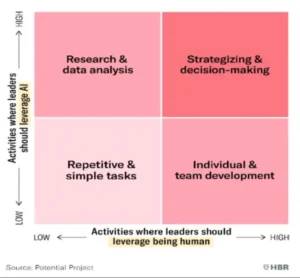
In a recent online article on the Harvard Business Review site (HBR.org, 2024), entitled “The Best Leaders Can’t Be Replaced by AI1,” the graphic below illustrates the authors’ conclusions on where AI should be used most effectively in organizations and the areas where « being human » should be leveraged.

AI Versus Human: A Matrix of Leadership Activities

A guide for leaders to assess where they should leverage AI versus where they should leverage being human.

The Recipe for Successful Leverage of AI: Human Beings Being (more) Human! - Mark Hollingworth

The area of strategizing and decision-making is identified as the one with the highest potential to benefit from using and leveraging AI—provided that high levels of “being human” are also utilized. I have already written an in-depth article2 demonstrating how generative AI tools can be used in the scenario planning process and explored the pros and cons of doing so. However, in light of the new HBR article, I thought it would be useful to explore what leveraging a high level of “being human” might entail.

First, we should highlight the possible negatives of being human that might be exacerbated through the use ofAI. For example, bringing our personal biases, fears, insecurities, selfish ambitions, personal enmities, jealousies, A.D.D., a tendency to empire build, and our ability to lie and deceive (others and ourselves) into ourinteractions with AI would probably best be avoided. Perhaps, over the long-term, new AI tools might serve todiminish or eliminate their impact on decision-making for the betterment of all.

To explore what a “high level of being human” might look like, I consulted four different generative AI bots. They all agree that there is an extensive list of human qualities, such as our emotions, sense of engagement, commitment and determination, personal ethics, integrity, judgment, personal values, our ability to empathize and be compassionate, deep listening, our passion, humour, sense of play, emotional intelligence, creativity, intuition, and feeling of connection, community, loyalty, trust, and friendship, that can all be important in strategizing, decision-making, and individual and team development. Interestingly enough, these are the elements of a human being that make each of us who (as opposed to what) we really are.

Our essential humanness

Our essential humanness includes our mindfulness, awareness, presence, and consciousness, our ability to capture what is and what is emerging. These attributes are not a function of our I.Q. nor do they reside in the physical brain. They are in what Annie Murphy Paul calls our “Extended Mind3,” an expandable sensing capability that continually “loops” between our brain-mind and our hearts, guts, body sensations, devices, technologies, local social field/space, and global consciousness.

Crucially, most of the human attributes important in strategic decision-making—and that are not replaceable by AI—do not reside in our heads.

Rather, it is our body’s interoception, exteroception, proprioception, and nociception sensitivity and capabilities, along with our “extended, looping minds,” which add unique irreplaceable human value. This “distributed cognition” capability allows us to create “the new” from the old and energize, engage, and mobilize our teams. After all, AI will never be able to be fully present and truly experience moments as they unfold or the emotional surge of the birth of a new idea. It will never experience the magic of individual or team “flow.”

Such a way of seeing ourselves and our value-added belies the belief of many educated professionals that, as the joke goes, our bodies are merely taxis that simply “transport our heads from one meeting to another.” It is, in fact, our ability to feel and sense into our hearts, guts, and bodies that allows us access to that essential humanness and bodily wisdom—or not.

Yes, given all the right data, AI can come up with the perfect “winning” business model, but so can any welloiled team of experienced, technical strategists who have mastered all the models and concepts. AI can just do it quicker. However, many of us who have been doing this work for a while know that having a bot announce the next business model, process change, structural reorganization, or strategic “pivot” will probably have as much success as the boss who devises the perfect decision in their office and walks out to tell everyone the major change they’ve decided is going to happen.

In another recent HBR article4, the results from a major study of 300 large companies worldwide show that, even with all the big data, new tools, and management experience in 2024, only 12% of major change (Transformation) programs produce lasting results. Just imagine all the lost time, money, energy, waste of human resources, and the enormous frustration, opportunity cost, and value destruction that is captured behind that statistic.

This failure has little to do with the actual quality of the decisions that were made. Such post-change “transformation” visions are often well-thought-out —probably the equivalent of anything that an AI bot could generate. The weaknesses lie in the lack of consideration of the “human experience” of the change/transformation processes and the inhumanity that exists in our organizational cultures, processes, strategies, structures, and decision-making.

Those of you who know me are well aware that I believe all the “strategizing” and decision-making models and concepts are nothing more than specialized tools to facilitate generative, embodied conversations. It is where the alchemy of creativity and innovation, co-creation, commitment, engagement, and team-building can occur. This “Flow” alchemy can only occur when full-bodied mindfulness, presence, and awareness are present.

The following paragraphs (unedited) show how each of the 4 Generative AI-bots I consulted finished their answers to my prompts regarding what a high-level of “being human” might actually mean:

ChatGPT

In essence, a manager with a high level of being human integrates compassion, ethical judgment, and a deep understanding of human dynamics into their strategic decision-making. This approach not only fosters a positive and productive workplace but also builds trust and loyalty among employees and stakeholders.

Gemini

The ideal scenario is a combination of AI and human intelligence. AI can handle the data analysis and provide options and insights, while humans use their judgment, empathy, and critical thinking to make the final decisions.

Copilot

Incorporating a high level of these human qualities can lead to a more holistic and balanced approach to management and strategy, fostering a work environment that values individuals and their contributions beyond just their output or productivity. It can also help in building trust, loyalty, and a positive organizational culture.

Perplexity

In essence, a high level of being human means not treating decision-making as a purely analytical exercise, but embracing the full richness of the human experience – our emotions, values, creativity, and ability to connect with and understand others. It results in more holistic, ethical, and impactful decisions.

This last statement, my personal favourite, best captures the reason why I believe “embodied decisionmaking”, that is, seeking to incorporate mindfulness and social presencing—along with full-body “strategic play” activities and movement practices throughout a decision-making process—is essential if we want to improve our global (12%!) “fail” performance in “transformation” efforts. We need to have strategic decisionmaking processes that truly allow us to “embrace the full richness of human experience.”

As described in my previous article5, the following closing paragraphs (generated by ChatGPT) perfectly captures my thoughts:

Social Presencing Theatre (SPT) (and other movement-based creativity methods) is based on the understanding that the body holds wisdom that is often invisible and inaccessible to the conscious mind. By exploring, observing and experiencing emerging bodily positions, movements, gestures and postures, SPT allows people to access deeper levels of awareness, creativity, empathy and connection.

Using physical movement (in combination with traditional tools) combines mindfulness, embodiment, and social systems thinking to help individuals and groups better understand complex system-wide patterns and dynamics and, as a result, to develop new perspectives and innovative solutions. Most importantly, these solutions are more effective and sustainable than solutions derived using more conventional decision-making approaches.

Only by recognizing, building and using our “extended, looping mind” competency i.e., our interoception, exteroception, proprioception, and nociception “muscles”—and risking being laughed out of the boardroom – can we truly capitalize on both AI and those unique human qualities that allow transformation to emerge, be implemented, and stick.

Having completed the above article, I asked ChatGPT to generate three Action items for you as “take homes”. It generated:


1. « Use AI to augment, not replace, human decision-making »

Focus the use of AI on data processing and pattern recognition, while humans handle the “human experience”, individual development, team-building and ethical considerations. Design AI tools to complement human capabilities.

2. « Implement Embodied Decision-Making »

Encourage practices like mindfulness, social presencing, and strategic play to engage the whole body and mind in strategising and decision-making. These methods foster creativity, holistic thinking, team building and a better understanding of complex system dynamics.

3. « Cultivate a Human-Centric Culture »

Foster a culture that values a human-centric paradigm and design thinking, empathy, ethics, and emotional intelligence. Emphasise these qualities in training and team-building to integrate human strengths with AI, improving both engagement and decision-making success.


In other words, bring more of your humanness (your entire being) to the workplace if you want to get the most from AI.

References:

1 “The Best Leaders Can’t Be Replaced by AI”: Rasmus Hougaard, Jacqueline Carter, and Rob Stembridge; (HBR.org 2024); Jan 12th 2024

2 Enhancing Scenario Planning with AI; Ivey Business Journal, May-June 2023

3 The Extended Mind: The Power of Thinking Outside the Brain; Annie Murphy; 2021; ISBN 978-0-358-69527-1

4 Transformations that Work; Michael Mankins & Patrick Litre (both partners at Bain), HBR May-June 2024

5 “What is the Unique Value of Social Presencing Theatre (SPT)?” LinkedIn; March 2023

Mark_Hollingworth

By Mark HOLLINGWORTH

MBA, M.Eng
Consultant expert in Team Management, Strategic Planning and Change Management
Further reading on this topic:


↑ Back to top of the page.

SETYM International Wins the “Business with Africa” Award at the REPAF Vision and Inspiration Excellence Gala

7 June 2024, Montreal, QC –

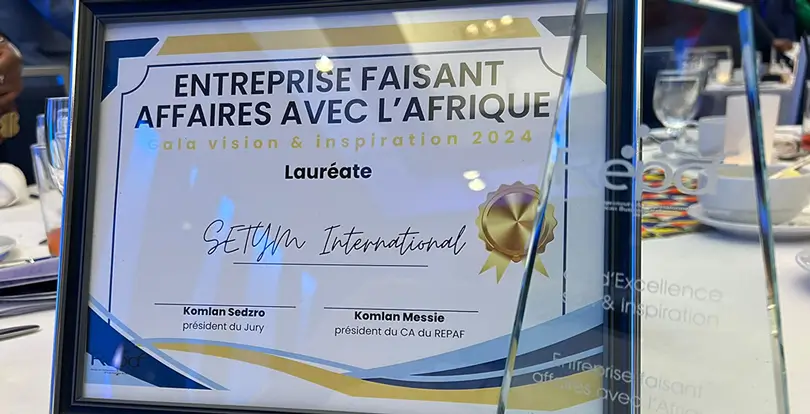
SETYM International was honoured with the prestigious “Business with Africa” Award at the Vision and Inspiration Excellence Gala, organised by the Réseau des Entrepreneurs et Professionnels Africains (REPAF). This ceremony, which celebrates outstanding initiatives and contributions by African professionals and businesses, took place on Friday, 7 June, in Montreal.

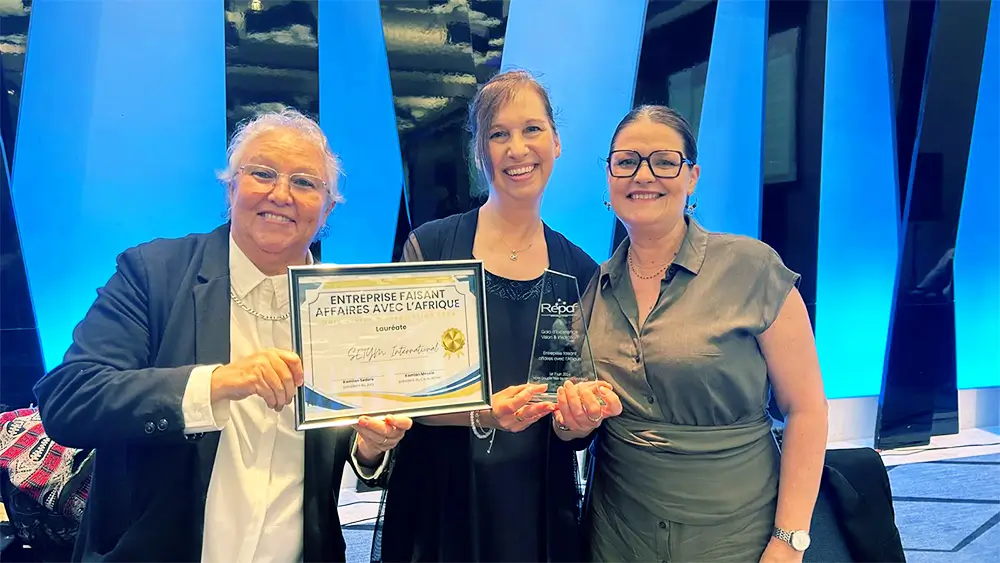
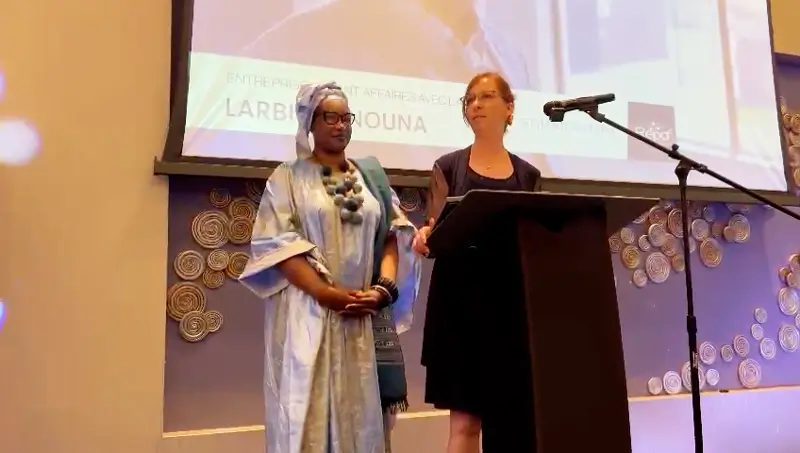
Ingrid Martin, Senior Coordinator of Customer Service at SETYM International, accepted the award on behalf of CEO Mr Larbi Bennouna. She was joined by Véronique Brissonnaud, also a Coordinator, and Soraya Benitez, Head of Client Experience at SETYM. The award was presented by Mrs Fatima Braoule MEITE, Ambassador of Mali, before an audience of innovators. This distinction reflects SETYM International’s commitment to promoting sustainable development and strengthening capacities across Africa.

“We are deeply honoured to receive this award,” said Ingrid Martin during her acceptance speech. “This recognition speaks to our hard work and dedication to making a meaningful impact across the African continent.”

Soraya BENITEZ, Ingrid MARTIN et Véronique BRISSONNAUD

On a Development Mission

The CEO of SETYM International was on a development mission in Africa and was therefore unable to attend the ceremony—yet another example of the organisation’s on-the-ground commitment. This absence was highlighted by Martin as “a living testament to our active engagement.”

The gala also spotlighted TransNumerik, another finalist for the award, showcasing the quality and impact of the nominated companies’ contributions. SETYM International extends its gratitude for being nominated alongside TransNumerik, a company that shares our commitment to sustainable development in Africa. The joint efforts of all nominees are essential to fostering a prosperous and sustainable future for the continent.

This award is not only a recognition of SETYM International’s past achievements, but also a source of inspiration for future efforts. The organisation remains focused on capacity building through professional training in emerging and developing countries.

In conclusion, Ingrid Martin expressed her gratitude and unwavering commitment to SETYM International’s mission:

“We share this victory with every member of our team, and we are determined to continue working with passion and dedication towards a brighter future in Africa.”

Ingrid sur la scène, acceptant le prix au nom de SETYM International

Mrs Fatima Braoule MEITE, Ambassador of Mali, alongside Mrs Ingrid Martin, Senior Customer Service Coordinator at SETYM International

Gabon: Partnership Signing Ceremony between EM Gabon – University and SETYM International

SETYM International Proudly Announces Strategic Partnership with EM Gabon–University

SETYM International, a Canadian leader in capacity building in the context of international development, is proud to announce a strategic partnership with EM Gabon–University. Signed on 16 April in Libreville, this partnership aims to deliver advanced training programmes for senior civil servants directly on Gabonese soil.

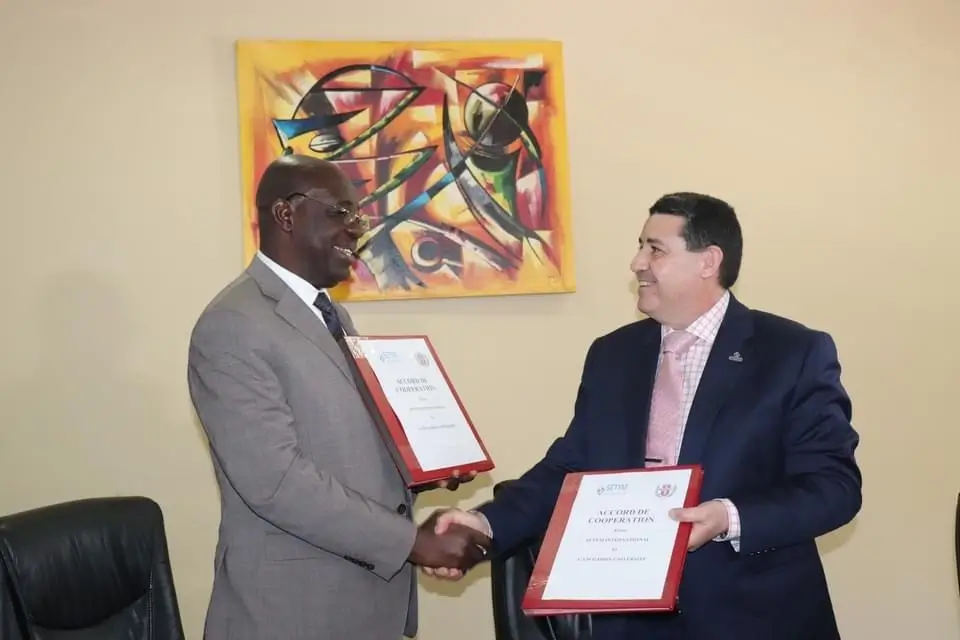
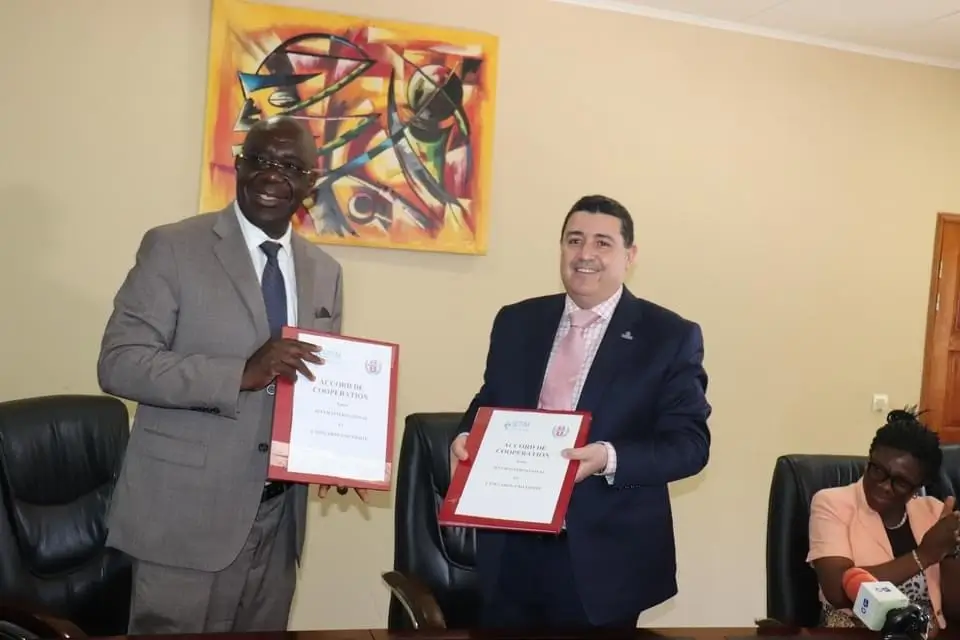
Larbi Bennouna, CEO of SETYM International, and Professor Daniel Franck Idiata, Director of EM Gabon–University, formalised the beginning of this collaboration with a signing ceremony. The partnership establishes a training framework designed to strengthen administrative and managerial competencies within Gabon’s public sector. This tailored initiative reflects SETYM’s mission to deliver practical, needs-based training for public administrations.

Strengthening Capacities

“By training Gabonese civil servants in Libreville, we are directly contributing to the development of critical skills required for the country’s economic and social growth,” emphasised Mr Bennouna during the signing ceremony.

This initiative represents a major milestone in SETYM International’s ongoing commitment to providing high-quality training tailored to the specific needs of Gabon’s civil service. The partnership not only supports local capacity building but also promotes sustainable development through accessible, practice-oriented education.

Professor Idiata expressed his enthusiasm for the project:

“It is a great honour to collaborate with SETYM, a globally recognised organisation. We are confident that this partnership will meet our government’s expectations and greatly benefit our executives by sparing them the cost and constraints of training abroad.”

This partnership is founded on a shared vision of continuous improvement in administrative capacities in Gabon and will contribute to enhancing the performance of the country’s public administration.

Monsieur Larbi Bennouna serre la main du Professeur Daniel Franck Idiata à la signature du contrat.

Read more on (In french):

Gabonactu.com                         Gabonactu24.com

Monsieur Larbi Bennouna avec le Professeur Daniel Franck Idiata, heureux de présenter le contrat signé.

Meet the winners of SETYM International’s 35th anniversary contest


This year marks the 35th anniversary of SETYM International, and to celebrate this milestone, we launched a special competition dedicated to our valued clients. We wanted to express our gratitude to those who have joined us in celebrating this important chapter in our history.

Prizes

This competition offered the chance to win one of five (5) free places at one of our international seminars in 2024, including airfare and accommodation. This unique opportunity reflects our commitment to promoting lifelong learning and enriching the professional journeys of our global community.

The draw was overseen by Mr Ismaël Coulibaly, lawyer at the Quebec Bar and partner at BENOÎT & CÔTÉ INC., an independent law firm. A list of anonymised participant IDs was provided to him to ensure complete impartiality in the prize selection process.

We are proud to reveal the names of the winners:

  • Mr André Benjamin RENE, Director of Administrative Affairs and Budget, Superior Council of the Judiciary (CSPJ), Haiti

  • Mr Alpha Issiaga CAMARA, Public Procurement Specialist, Project Coordination and Implementation Unit (UCEP), Guinea

  • Mr Christian MUHINDO KABUYAYA, Division Head for Programme Budget Planning and Monitoring, Ministry of Finance, Democratic Republic of the Congo

  • Mr Allou Koffi Charles B. AKA, Senior Project Coordinator, CÔTE D’IVOIRE ENERGIES (CI-ENERGIES), Côte d’Ivoire

  • Mr Winstone MPINDU, Zambia Electricity Supply Corporation Ltd. (ZESCO), Zambia

These fortunate participants will once again experience our high-impact training, designed to meet the challenges of a constantly evolving professional landscape, while benefiting from the expertise and know-how of SETYM International’s experts.

We extend our heartfelt thanks to everyone who took part, and to all the Setymians of the past 35 years.
Your passion and dedication to continuous capacity building are a true inspiration and the driving force behind our mission.

Our Commitment

For the past 35 years, we have been dedicated to delivering the highest quality training and contributing to the professionalisation of your fields through our specialised accreditations. As we celebrate this anniversary, we reaffirm our commitment to strengthening the skills and knowledge of our international community — always with the warmth and hospitality that define the SETYM experience.

Congratulations to the winners — and thank you all!